Showing posts with label BA2a. Show all posts

BA2a- Evaluation

This project without a doubt has been the hardest out of all others so far, for a variety of reasons, one obviously being the fact it’s been the longest. I tried hard early on to gain as much as I could about UE4, spending too much time experimenting with 3D despite knowing I was going for 2D. I really struggled to understand blueprints and if there was a node that existed for what I wanted, but having spent the time I have, I can now fairly autonomously blueprint a range of basic mechanics, having a toolbox of sorts. I left my Pitch Document right up until the end when both should have been done together, all my time spent away from home where I could access UE4- when I could have been working on my Pitch Doc.

I did organise my time a lot better with the help of Trello and despite my struggles with blueprinting, sought out ways of using what I learned from tutorials, like all the mechanics behind UE4s 2D platformer default., building my own from scratch. I then applied this knowledge with newfound information on animation, learning in my own time to create a walking sprite and have it turn like the default sprite does.

I chose to create a game that was deeply personal, which straight-off I had reservations about, not wanting to go to deep. However I decided to go along with it, as it was more unique and appealed to me more than my other, more ludic ideas. This was a mistake. Whilst I’ve created a prototype I’m incredibly proud of, almost every interaction and mechanic being a metaphor, players entertained by my game for large lengths of time as of the flow I’ve created, the price has been absolutely massive. Perhaps too personal for an evaluation, but I as a human being create this work, I’m the key component to it. My mental health has been the worst its ever been, accentuated by the dilemma of so much new information to learn and deadlines, every day I was focusing on my problems that fed into the game. Every day I really focused on large maladies, living and breathing my problems, I was mentally far too focused on the negative. This led to me being very ill and having to miss out on the games jam week, but I'm grateful I did as I needed that brief week of respite to be able to continue into specialism.


I Intend to catch-up and gain some games jam experience very soon. I’m very proud of my specialism work, whilst aware I need to practice environments and materials, they were the most fun I’ve had studying thus far. I was told to perhaps create an animatic for my eel gun, simple 2D animation communicating design. Having an interest and brief experience with animation on my game, 2D as well as 3D animation are things I’ll explore during personal study. 

Specialism: Prop Design Week 1 and 2

For this art test, I chose 2 of 4 briefs, both under prop design. One featured a Victorian aesthetic, the other a more futuristic one. Personally, I detest guns and find them dull, so I decided to design the most fabulous gun I could. I'm also not a fan of sci-fi, so decided to tackle that in creation of a crate.

Starting with the Victorian object, I roughed some silhouettes on items I thought were interesting of the time, in shape and form.

Having decided to go with the gun idea, I used silhouettes and a digital collage technique new to me, which was helpful in its own ways.


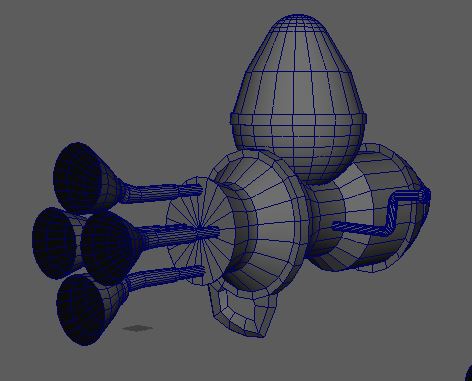
Roughing some ideas further in my sketchbook, I was very drawn to the idea of an eel gun. It was madcap and had historical relevence, there being an influx of eels during the Victorian times. What do you do with so many eels? You weaponise them. Liking the fact electricity had to be cranked to use a Victorian phone, I added that to the gun, wanting it to have be a four-barreled blunderbus after looking into guns and how they worked and what might work the best, the wide nozzle of this particular gun making the most sense. 


Having roughed more ideas, considering other things like Queen Victoria's jubilee ( a royal gun seeming reason for elaborate design), I decided to go forward and model and paint over my strongest idea.


With an eel tank on the top and a crank on the side, I felt this worked. But then, how would it be carried? How would it be used? Surely its too heavy, too large? So I worked on some further concepts.


Then, size in mind, I looked into flamethrowers of WW1 and a tank strapped to the back of the user made more sense, though the idea of a horse -drawn-eel-spewing-turret-carriage was compelling.

Using Maya further, I developed the small zapgun like gun through iteration, closely studying a book on Victorian Stencils, developing them into forms of the gun, elaborate patterns becoming scopes and adornments.


The idea of the back pack was to have it as a refurbished coffin, being quite common in this era in not having enough graves for bodies. The size would have to be that of a child, made of metal, which was seemingly common in the bourgeois.


So here we have my eel gun. The main idea with this brief was that there was an organic element of the item that was rotting and causing it to malfunction. Ignoring science, the gun would be used with live eels as a sort of Victorian taser, a crank electrifying the eels. But in Frankenstein fashion, electrifying dead eels brings them back to life, free to spread a vast zombie-eel plague. In hindsight, a plague mask should really have accompanied this item.

The next item being sci-fi, it has to be a crate holding a deadly substance that's been badly damaged, the substance now leaking.


From silhouettes, to sketches, to iteration. I was very taken with the more Utopian route of robotics seen in curves, beveled edges and a prominence of white. Portal, I-Robot and Wall-E's Eve being points of reference.


A sci-fi crate that prisons a liquid monstrosity, bullet holes allowing tentacles to slip out, explosives opening whole segments and a crudely hacked and broken control panel.

Despite not really ever tackling props, I've really enjoyed this. Though some texture studies would help me out a lot!


Research- Focus on Mazes, Morality and Meta- Proposal

Having originally wanted to base my essay on the idea of meta-games, linking that to mazes and labyrinths, exploration and interaction of the game making use of paths outside itself, I have refocused this idea, by applying it to the games Undertale and Virtues Last Reward.

With a focus on morality and choices, the idea of the labyrinth and the meta qualities of both games interwoven with these themes. Citing the likes of Epsen Aarseth to explore these games as ergodic literature, I'll also be exploring Bertolt Brecht's idea of alienating an audience and Antonin Artaud's concept of the Theatre of Cruelty, doing the polar opposite. With a wide scope on morality and ethics, I'll also be exploring the John Nash's Prisoner's Dilemma, an integral theme and mechanic to Virtues Last Reward and exemplified at key moments within Undertale, as well as Adam Smith's concept of "The Invisible Hand" and the selfishness of Man- both games looking quite deeply at the morality of mankind and critiquing it. The emotional dilemmas this offers up to the player shall also be explored through narrative and player interaction with what Aarseth calls a "cybertext", and how this links to the integral part of Mazes- to gain strength and betterment- exemplified further by the Christian context of Labyrinths.

Within the context of Meta and Labyrinths and Morality, John Clowder's Middens fits all of these: a large visually obscure maze-like world to explore, where every character can be killed indefinetly and that in its finale, preaches that all living things are bored and want to die. Summarised with this line, directed completely beyond the 4th wall, directly at the player.


 All my notes for this Essay:


Final Playtesting for Interactivity

Having tweaked Timor from previous personal feedback and play-testing, I conducted some more.

These tweaks were placement of instruction and a few more Notions describing mechanics, the lights intentionally very hard to find. When adding the harp sound effect, I ran into a problem with the blueprints.


I'd added the sound playback from using the harp at the end, meaning it would only sound when it deflected an enemy, and I wanted it so the player could use the sound whenever they wanted, so shifting the position...


The aural feedback would occur and be checked for before the blueprints check if an enemy is in the vicinity, playing the sound at a button press!


On the initial playthrough, my first player was incredibly intimidated by the Ennui, the slow creeping movement and sudden appearance when running fast having quite an affect. When the Harp was found, the sound feedback was so appreciated, players kept spamming the button, to dispel the enemies and enjoy the added sound effect of the harp. Playthroughs were quite long, the map at first alien and new, after a few tries the player started learning the map and exploring, really enjoying the discovery of the Notions, wanting to explore further. Slipping through the world as an embraced mechanic really works, the player dismayed when this bug wasn't in effect, no longer having the freedom to bypass walls. My player was "really sucked into what you can find in the game" and really enjoyed exploring the map, qualms being a light counter and or a small map, however I'm adding neither as the metaphor behind the game, I want my player to feel lost, slowly learning the space and to have the persistence and incentive of discovery to keep going. Following on from contextual studies into research into mazes and labyrinths, my game is very much a multicursal maze, with dead ends and alternative routes, there are enemies in my maze and special items to collect that strengthen the player, following my findings on the idea of mazes making the player stronger for having explored it.

I've conducted only personal research because the nature of my game is quite personal, letting the players experience the game alone and connecting to it on a more personal level than me asking people to fill out a form. Then, sitting with the players, watching their reactions and how they interact with the denizens of my game world, offers much insight and demonstrates the effect my game can have on different individuals.

My next player dealt with the game in a much more jovial way, the Notion pleading the player to not leave it, caused my player to exclaim he won't staying still for a few minutes to see what would happen. He gave the Notions their own voices and dialogue as he was playing, the words really compelling him to look for more; taking th time to stop and read had both my players quite immersed, play time lasting roughly half an hour plus for both, I've really created a game with flow here, my players enjoying the fact that the more you play, the more you learn and the more immersed you become.. The harp mechanic was particularly enjoyed, and more functionality was requested, like different notes and the ability to play songs. The two modes were seen as each having drawbacks and advantages, both being fun to use for the player but floating preferred, a common trait among players. When Death was encountered, ending the game had the player confused and didn't know what to do or what the consequences were, so continued to play.Finding areas undiscovered was exciting but scary, not knowing what new dangers lurked nearby. It was noted that the game being large but sparse was quite effective, it feeling lonely and the few things you could find had a lot of value to the player, some being sad for some, some being highly amusing to others, this dialogue and writing is the driving force of Timor, and has been very well received by all players. My playtesters enjoyed the prototype so much I was asked to really develop it to see what it could become, something I feel I'd really like to pursue.

Circuses and Arenas/ Fairgrounds and Themeparks/ Art,Animation,Film/ Wargames and Sport- Research- Whistle-stop Run Through


Stemming from the arenas of Greece, fighting games are a clear link. 2D fighting games such as Blazblue, Street Fighter and Mortal Kombat pit one against another, battling to the "death". The popularity of these games within Esports, often streamed to a global audience via sites like Twitch, shows the spectacle of a fight appeals to a wide number of people, just as it did to the Greeks, this is the reason Multiplayer Online Battle Arenas (MOBAs) are so popular. Many combat-centric games feature the idea of an arena, be it the hack and slash antics of the crucible within Darksiders 2, a distraction from the main quest where you take on many waves of enemies to unlock coveted prizes, or the much more docile Pokemon Stadium, a spin off that focuses on the combat element of the game, rendering 2D Pokemon in 3D models in more detailed environments. The idea of a Boss fight, a challenge a player must face and conquer to progress, is often an exciting one to the player, often rewarding the player with a new skill. Playing Legend of Zelda, an astute player may look at their map and find an unexplored, large, spherical room and deduce thats where a mini-boss may be- the room appearing like an arena in shape, large and spacious. Games that focus around boss fights primarily, are built on this idea of player anticipation, excitement for the spectacle; within No More Heroes  the identity of each assassin you must kill to climb the ranks is hinted at via a silhouette and a quote before each level, players traversing the unicursal labyrinth of the playscape to reach the Boss.

Circuses similarly, focus on this idea of a spectacle, exciting the spectator with wild, strange and new things to beguile and entertain. The game Kingdom Hearts: Dream Drop Distance has the player pulling off visually dynamic acrobatic feats during combat, but also helper monsters, many of which in colour and design resemble carnival aesthetics, a performing seal and an adorned elephant being examples. Many games feature mini-games, some are made entirely of them, smaller self-contained interactive moments, set up in a way similar to a carnival, many small games available to try. The Sega owned franchise of NiGHTS is an ode to the Circus, the player taking on the role of a flying jester-like character, performing aerial acrobatics to accrue points, defeating circus inspired enemies such as freakish balloon-like clowns and shapeshifting, a visual spectacle as the protagonist takes on drastically varying forms to achieve a variety of feats. The fact the player must fly through hoops is no coincidence either. NiGHTS has a thematic focus on dreams, offering both the Dystopian world of Nightmares, and the Utopian one of dreams where all is possible, colourful and exciting.  


This idea of Utopia is incredibly strong concerning the realms of Fairgrounds and Theme parks. Crafting a world that is coherent throughout, with different themed sections of the park and themed foods and even toilets, this is furthered in the Super Mario franchise, in game there being a variety of different worlds, a lava, a jungle and spooky world all coming to mind. The hub area of Super Mario Galaxy is a sprawling environment you can fly around to explore, catapulting yourself to different sections of the map to access a plethora of other worlds. Real life theme parks such as Disneyland are seen in the game Epic Mickey, the player wandering a dystopian version of the utopian park, fighting nightmarish amalgamations of old park rides and traversing 3D renders of the parks, even finding a secret virtual version of Walt Disney's house. The game Kingdom Hearts is heavily influenced by Disney, the latest game featuring a mechanic where you summon parts of famous Disneyland rides to battle enemies, using a rotating teacup or mowing down enemies with the Park Train for example. The game series Scribblenauts Unlimited is a sort of sandbox game where you have the ability to write anything and have it appear, the games library of possible items being vast and deep, the world becoming a place where anything is possible due to your omnipotence, the game world a playground for you to explore and overcome challenges in creative ways. 


The worlds of the Arts have great influence on games today, many take direct inspiration from famous artists and movements, Okami's visuals reflecting the woodblock prints of Japan as you travel a fictional Nippon, Monument valley takes direct inspiration from M.C. Escher's work as you explore the isometric world and the popular indie title Transistor takes much from the work of Gustav Klimt. Games can be a tool for art, the touch screens of the Wii U and 3DS utilised in Art Academy that aims to teach the player how to paint and draw better, games themselves can be considered works of Art, the combination of visuals, mechanics, soundtrack and animation creating memorable lasting experiences in the games by Thatgamecompany such as Flower and Journey.The game Lumino City that takes place in real life, handmade dioramas, set peices being handmade for the game whilst Tengami weaves a Japanese inspired narrative through Origami visuals and pop-up-book mechanics, pulling tabs to reveal secrets etc. The Beginner's Guide is much more of an interactive film than a game, heavily using theatrical techniques in weaving a narrative such as the use of Checkov's Gun, in this case a very literal example.  


This category centers mainly around Agon play, competing head-to-head with another. War games cover the obvious, Call of Duty, Battlefield and any other FPS where as Spec Ops the Line serves to emulate and undermine this set up, critiquing the play and the fantasy of being a hero when the reality is very different. The game This War of Mine focuses on the human aspect of people surviving war zones and the moral dilemmas that come up from trying to stay alive, do you invite in the other refugees who you know nothing about, or do you turn them away as your rations are meager as is. Tower Defense games focus on the player fending off waves of attackers by fortifying their own fortress, laying waste to armies that seek to level your kingdom. TN games' gaming vest allows players whilst playing FPSs to feel pain through air compressors, to feel immersed "in the heat of battle like never before", a tactile way of interacting with the violent nature of these games.

Sport games range from  officially licensed titles such as the annual release of new FIFA games, to more fictional mascot-led affairs with the cast of the Super Mario series, tennis rackets becoming hammers, baseball bats imbued with magic. The latter being more child friendly and making the nature of the sport more accessible, promoting the fun qualities of the activity. Games such as the popular Mario Kart, gather a large social spectrum of people to play against each other, connecting people through digital sports. So within War Games, it could be argued to be a more serious affair being strongly about two opposing forces, whereas sport within games has much more of a sense of camaraderie.

Books and Comics- Research


On the topic of books and games, narrative would be a clear aspect to cover, starting with the insurgence and popularity of episodic titles, a road paved by Tell Tale Games. They offer a few hours of gameplay and are usually heavily narrative focused, often with choices to make that effect the story later, Life Is Strange as an example. Narrative and story telling are arguably more important in these kind of games than gameplay, with a focus on good writing, multiple story arcs, character development and relatability. All covered in another Gamasutra article, written by Pascal Luben, its stated that its in fact the audience themselves that drive central writing decisions, a secondary character can easily become a main one if the audience's reception is largely positive, script writers follow the reaction of their audience and write accordingly, comparable with the penny dreadfuls of Charles Dickens. The game Virtues Last Reward is much like a playable graphic novel, it having many chapters and storylines and cliffhangers that have you feeling differently about characters, each timeline in the game comparable to an episode.

Harry Potter: Book of Spells came with a peripheral entitled the Wonderbook, that heavily focused on AR and allowed players to interact with visuals coming from the book and learn magic spells, an extension of the famous book series and a sort of digital toy. Similarly, the game Ni No Kuni originally for the DS came with a book called The Wizards Companion, the PS3 port came with a book too but it was purely for a collector's sake, the DS version contained runes and patterns that taught the players what to draw on the screen for each spell, for certain spells a connect the dot puzzle and other such physical puzzles had to be solved for use in the game. It also offered crucial clues and had a bestiary, it was a companion to the game that could be played without it.

Ancient tales such as Dante's Inferno are re-imagined, becoming a hack and slash romp through the circles of hell complete with action game staples like combos and quick time events. Similarly, American Mcgee's Alice is a dark a gothic twist on the original text, featuring demons and grotesque sights peppered with the absurdities of the original text, playable as a 3D platforming adventure game. The Witcher series of games actually stem from Andrzej Sapkowski's series of novels, life breathed into his text through games. As there are games based on Novels, there are now novels based on games, a long list of Assassin's Creed books can be found among others.

A strange old game for the PS1 is Parasite Eve, an early age action RPG that serves as a sequel to a book with the same name by Hideaki Sena, that was also developed into a film and manga. Its a sci-fi horror story about our own genes being sentient and turning on us, led by some creature known as Eve, the game continues where the book left off, a form of transmedia storytelling, the later games following the Manga series. Due to the limitations of the PS1, dialogue was written not spoken, words being capitalised for drama and emphasis. Virtual books and texts within games serve to push narrative should players choose to engage with them, RPGs like The Last Story featuring a Library you can go to to read about the lore of the world, Metroid Prime having a scanning system, allowing the player to read thousands of lines of text about creatures, the game world and its cultures should a player choose to.

The game company Cing, bankrupt in 2010, created many novella like games, rich in story and character, and they unfolded much like a mystery novel. Vice President at Cing Rika Suzuki fondly remembers their partnership with Nintendo who championed narrative led gaming. The games were very puzzle focused and had players mentally breaking the 4th wall multiple times, Another Code for the DS featured a puzzle that could only be solved by half closing the DS itself to see a reflection, the Hotel Dusk games had the console held on its side, much like an actual book. Cing made "mysteries out of mundane occurrences and complex human portraits" where other games that attempt mystery may feel rushed and have archetypes- "dolls without cohesive motives". Cing "spun novella-length yarns out of theirs casts" and the game Hotel Dusk featured rotoscoped sketches to animate the characters in a bewitching way. Quotes and info taken from Stephen Turner's article on Destructoid.

Spec Ops the Line, breaks the 4th wall consistently and parodies the nature of shooting games, mechanics echoing PTSD, it also takes the premise of Joseph Conrad's novella, Heart of Darkness. However instead of the Congo, the game takes place in sand swept Dubai. This Spec Ops info was taken from Chloi Rad's article on IGN. An obscure title known as The Dark Eye was playable on the PC in the 90s, it was a strange mashup of lowres environments, claymation and spoken dialogue, following the stories of Edgar Allen Poe, the visuals eerily lending themselves to the narrative.

Comic book heroes are widely seen in games, be it movie liscensed, the Batman Arkham Asylum games, the Lego games or even in a specialised version of the game Scribblenauts: Unmasked, liscensed and featuring many iconic characters. Fighting games create worlds where these characters can enter exciting and action packed scenarios reflecting the original media, Marvel vs Capcom and Injustice Gods Among Us being prime examples. The Borderland series features a strong aesthetic resemblant of older comic books, with strong black outlines and vivid colours. The DS "bullet hell"title Big Bang Mini featured a world based on New York and comic book iconography, the bullets being onomatopoeia, the player avoiding all manner of "BOOM" and "ZAM".

Games pushing narrative, offering a more tangible story than books can through visuals and interaction, books as tools to be used in games and games that bring older tales to newer, contemporary audiences. Episodic titles and interaction with audiences are key points to perhaps develop.

Arcades and Parlour Games- Research


Arcades were incredibly popular during the 90s, but have since become obselete with the power of home gaming consoles allowing player access to hundreds of games, right at home. It was a disarmingly cheap (until you were on machines for hours!) and fun place to be, put in a few coins and play a game, forever wanting to improve or beat and progress in a game, these gaming machines were compelling and had ways of making you part with your change. Much of the following information comes from Jordan Zolan's article on "The Decline of the Arcade" on denofgeek.us.

Games like Space Invaders, Donkey Kong and Pacman were present but other machines during the 90s held Mortal Kombat and Street Fighter, games that weren't available at home, so you'd practice and play in these environments with other kids and teenagers to get better, to play against each other, to cheer each other on and feel a sense of camaraderie, united in real life by a love of games. "Arcades offered even the shyest kid to become King of the Castle" when having skill at a certain game, there'd often be "some unbeatable kid" you'd want to try and beat. This sense of union has now been facilitated through online play and voice chat from home consoles and PCs, you can play games with anyone in the world for as long as you like with one payment and not have to leave the house. Echoing Kazuki Takahashi's opinion on the lack of human connection, enforced by online play, this sense of union has been arguably filtered. I myself recall great joy as a kid going to an asian Arcade every so often, that had many machines only found in Japan. I remember putting all my pocket money in this card based beetle game "Mushiking", collecting cards from this machine to scan them in and power up my growing collection of beetles, swapping them with my friends and wanting that guy who poured all his money into the game who had the rarest cards- I still remember the glee of finally getting the butterfly special! It was this space, this world, this community with tickets and food and smells that was so wonderful, which has somewhat been lost in the takeover of todays home consoles an online-play as standard.

Fighting games and watching everyone else play, jousting with the other and when including eSports, its easily comparable to the idea of Greek Arenas. Who will beat the other? A fictional world where there may be bloodshed, but no harm will come to the player, as is the joy of video games. Arcades still seem to be in great use in Japan however, the game series Blazblue for example release console disks and arcade machines in tandem, the latter coming out before so players can already begin sharpening their skills. At tournaments, its not uncommon for these players to use joysticks and buttons, akin to those used on the machines.

Hubs in games, like the theme-park-centric Nintendo Land or even the home screen of the Wii U itself, try to create a digital community, the "miiverse" an online place to share tips and talk about games, trying to add a social element to the game you may be playing alone, making friends from a love of a series, as kids may have once done in arcades.

Arcade game mechanics have easily transitioned into gaming of today, games like Super Meat Boy and The Binding of Issac are designed to be difficult, but have a "one last try" appeal and a rapid reload time so you can get straight back into the action after you've failed. From Edmund McMillen's Gamasutra article, the "penalty for dying in video games started in the arcades where the major penalty was adding a quarter". As games appeared in homes and quarters were no longer necessary, the goal in games shifted from high scores to completion. Super Meat Boy's levels can be seen in entirety by the player, they know the ending is in sight, like the later mentioned Wario Ware, these bite size levels come in rapid succession so there is enough variety for players and they don't have time to get frustrated, they want to try the new challenge. "Video games are exercises in learning and growing", when a player completes a level, they can see a replay of all the times they died and the one time they did it faultlessly, congratulating the player for achieving something difficult.

Various iterations of classical arcade games have also made appearance on consoles, the DS game Pac-Pix heavily features the gimmick of drawing Pacman and other symbols, when the console and idea of touch screen controls were new. Another DS game in Space Invaders Extreme tried to reinvent the game for a contemporary audience, introducing flashy neon retro visuals and new powerup mechanics like a large vertical laser and bombs, to add some spice to the archaic game. Players nowadays can have their own digital library of games, be it digital or disk- games that focus on mini games, like Warioware, have an arcade feel in gaining extra credits and seeing how long you can play, before the game gets too difficult. Many video games feature arcade-like mini games, such as a playable games console within a game like No More Heroes, where the geeky protagonist plays a "bullet-hell" based on a fictional anime, to attain high scores, which serves as little more than a virtual...virtual distraction. Games within games.

The Parlour game in comparison unites people in a similarly social way. A largely Victorian pass time popular with the middle and upper classes, it was "the golden age of the parlour game" as stated by Patrick Beaver in his book on the topic, these noble men and women having a lot of free time. Mass Media such as radio and television and now games dwindled the play of parlour games, however they are sometimes still played today, often at Christmas or parties. Many have evolved into bourd games. Many of them make use of theatrical skill such a s charades, physical activity and word play. Games include word association, wink murder, Mafia, The Minister's Cat and snapdragon- a game that must have been played by the bourgeois as it was about snatching raisins from a bowl of flaming brandy in a darkened at the risk of being burnt- the idea was to see each other as demons, lunging for fruit over flames.

Many party games could count as modern day parlour games, and make use of peripherals to enhance the experience. The popular Guitar Hero has players competing against friends, to "play" a song better than the other, bringing people together in a physical way for a digital medium, Singstar and other karaoke games could also fit this bracket. The game Keep Talking and Nobody Explodes can only be played with two people, one with a screen and a virtual bomb to diffuse, and the other with a physical 27 page manual that must be printed out to play. The bomb diffuser has wires and puzzles to solve, consulting the other player who has the manual but cannot see the bomb and vice-versa for the other, this leads to a challenge of explaining and talking the other through tasks to diffuse this bomb within a time limit. A brilliant game is Jack's Box, which makes use of the player's digital devices such as smart phones and tablets, to enter online rooms and use these devices as controllers, to play drawing and word based games, interacting with everyone in the room in a digital manner, comparable to the deeply social and physical Victorian parlour games.

This idea of games asking more of the player than just use of a controller, of being tactile, is interesting. Games like Metal Gear that continuously break the fourth wall, a famous boss fight not telling the player they had to swap controller ports, was a way of engaging the player outside the screen, engaging them more with the world within as its directly interacting with them. Games like No More Heroes and Fragile Dreams make use of the Wii Remote's speaker, phone calls in No More Heroes, prepping you before each boss fight, have you hold the remote to your ear as you wander an intentionally large, empty virtual space at a slower pace, to absorb this information in a physically engaging way, traversing virtually to support this "phonecall". AR in the driving force in Fatal Frame Spirit Camera, that comes with a physical book filled with markers and a lady who sits in your room, talking to you through AR, having the player physically walk to find her. Comparable to the upcoming Pokemon Go, players physically wandering to find Pokemon. Games breaking the 4th wall and having the player interact physically I find massively compelling, it could be a good strand to really explore!


Board games and Card Games - Research


Mindmaps for the two themes. Mario Party,which focuses on players controlling characters from the franchise, navigate a virtual board using dice to determine how far the player can go. There are different spaces with different affects, different boards with different events, and mini games to play at the end of everyone's turn, items can be used much like chance cards.

The game series Fire Emblem plays much like Chess, being a tactical rpg with board spaces, units moving in specialised ways, yet there's an added rock/paper/scissors element to weapons and their effectiveness. Any tile based tactical rpg also counts as a war game, and has links to Chess, Fire Emblem developing the core game with visuals, actually seeing these units do battle.

Many classic board and card game have been digitized, Solitaire used to come pre-installed with most computers and can be played on the iPads of today, many digital games bundle a wealth of these analogue games together in a single product, seen in many portable titles.  The game The Political Machine serves as parody to the American Presidency, small figures representing current real life leaders travel around a virtual America, converting states to their party and gaining money, making a virtual bourd game of a real life event in human culture. Tharsis is a game set in space, where a digital dice roll determines what happens to the crew of your ship, whilst Talisman which is based on an analogue game, that works off older generation digital rpg tropes, features item cards, magic spells, an experience system, skills and stats, much like Dungeon and Dragons, the imagined fantasies of these analogue games better realised through games- see Eye of Judgement.

Guild of Dungeoneering has you laying out a dungeon from cards, creating a sort of board of play, as a small warrior makes their way through the map, battling the monster you've set through cards representing attacks, the highest winning. A card based battle system appears within Kingdom Hearts: Chain of Memories, where every action during battle is a card, if your enemies card has a value that is higher, you cannot use that action, exhausting all your cards has you reload the deck you constructed for the fight, whilst stacking cards of a certain type and numeric value allows the  player to use aquired skills.

The popular card game Yu-Gi-Oh featured a spin off, that took the monsters of the game and put them in a board game setting, players constructing the board with cube nets with every dice roll. A lot of games with pre-order bonuses come packaged with novelties, a pack of playing cards printed with characters from the game is not uncommon. The game series Persona heavily references Tarot cards, as core features and mechanics, categorising summoned monsters based upon the characteristics of the Major Arcana, acquiring new cards (new monsters) has you plucking a card from a deck and tarot spreads are used to fuse them, to gain stronger ones. Final Fantasy Fables: Chocobo Tales featured a card dueling system, where you pitted cards representing monsters against one another, using special abilities and various effects, its complexities comparable to the aforementioned Yu-Gi-Oh.

The Eye of Judgement was a game for the PS3 that made use of a camera peripheral that went by the same name, collectible trading cards where distributed with the game alongside separate decks and booster packs. These cards when placed on the 3x3 grid also given with the game, which under the camera, would bring forth 3D AR digital creatures. The aim was for one player to claim 5 squares on the grid, each summoning monsters, trying to populate and defeat the other to achieve that goal, spell cards were also used, held to the camera to activate. The fantasy within Yu-Gi-Oh becomes somewhat of a reality here, online matches possible with many cards to collect.

Nintendo themselves, before video games, produced Hanafuda cards, a version of playing cards that were produced during the ban on gambling under the Tokugawa Shogunate. This set had 12 suits, one for each month. with a set of 4 that correspond to a flower in each, usually 2 were normal and 2 were special. There were many games that could be played with these cards, much like the contemporary decks we still use today.

Yu-Gi-Oh itself as a card game was originally a spin off from the popular Japanese Manga, that developed into the incredibly successful collectible trading card game it is today. Kazuki Takahashi wanted to base his story around the theme of games, inspired by role playing and tabletop games that create communication between real people, he feels that a true connection or communication cannot be achieved via the Internet. His story's protagonist transforms from a child into a cool, invincible adult when he plays games, Takahashi believing a player becomes a hero when playing- entering Huizinga's magic circle.

It could be argued that this Japanese card game, being based around monsters, is due to the culture of Japan. Yo-kai being an incredibly important part of Japan's heritage, these monsters are still present today in games and other media, looking at Pokemon and a further iteration, Yo-kai Watch which has players battle and collect these familiar creatures. Games that heavily feature monsters, often come from Japan. Japanese Role Playing Games are rich in monsters; slimes, skeletons, ghosts, dragons- one merely has to gaze at the popular Final Fantasy series to see a wealth of mascot monster characters- perhaps this is why mascots and other cute creatures are so celebrated in the East. Collecting and trading them was a large part of the appeal of Pokemon, which in turn became a well loved card game, trading and collecting the cards as you would the monsters. There's a sense of community, as mentioned by Takahashi, from playing card games, and by extension, board games- the fact there are still modern analogue games being produced is testament to the fact there is still a place for these games today next to their digital counter parts. Games bring people together, there are sprawling online communities dedicated to video games, people meet up in real life to discuss games at expos- from first hand experience, a lot of these people will also take part in games such as Yu-Gi-Oh when socialising.

Some interesting strands here are the collecting and social aspects of card games and bourd games, as well as the iconography of monsters, that has deep roots in Japanese folklore.

The Persona games as mentioned earlier, heavily feature monsters and the Arcarna, each card of the major Arcarna being part of a cycle of continued growth. Certain characters represent "social links" within the game, representative of each card and the struggles towards growth when following this path. The minor Aracana features suites of commonly cups, pentacle, wands and swords- a link could be made to the four suits of contemporary playing cards- complete conjecture here- The Fool of the major Arcana could be the Joker in the pack. These four suits deal with more minor problems and tasks in our everyday lives, wealth, social interactions, creativity and rational reason are circles of knowledge they cover, the people on these cards represent the people we meet in our every day lives. These smaller tasks could be linked to side quests in RPG games, if this was explored much further.


Art Test- 2D Character Concept Art- Monkey Island TellTale Games- Week 2

Second week of Art Tests, I worked with my final design, first creating a model sheet for the human form...

I tried to take on a 3D modeler's perspective, as my character's in a loose patchwork coat, the body underneath would often be seen, so I presented that and a size comparison. I considered having the bag on a seperate sheet, but though it would be easier to have it all on a large image.

For the character sheet

I tried thinking more from a riggers point of view, butting bones in the beard for animation's sake. Some very loose sketches explaining posture and overall feel.

The twilight form, where my shopkeeper takes on the form of a seasnail...

The chest on the back I thought could use some different perspectives.


The character sheet here serves to illustrate the jokes to be had at its expense, expressions and player interaction.

The character piece, with of course some reference from yours truly, mainly for gesture and expression.


A line and block-in, I wanted to include the snail form and have some duality in the composition, but the forms being so different in shape, I couldn't find a way of having the two with it looking balanced, explored in very tough pencil thumbnails.


To the value and colour passes. I received some critique about focal point and value, the lighting needing to direct the eye, the gems needing to be pulled out a little more, so going back to the value layer and adding some highlights and experimenting mildly with a texture brush...


I was concerened this would obscure the character, but it adds far more mood. Im full aware environments should be something I practice in future, some texture studies wouldn't go amiss either. On to the next Art Tests!

Art Test- 2D Character Concept Art- Monkey Island TellTale Games- Week 1

Project Monkey Island: Lost Cove 

Project Description Telltale is creating a new installment in the Monkey Island franchise. Following on from its successes with Game of Thrones and The Walking Dead. Lost Cove features a mechanic where the player can switch between normal day time and a mystical and spooky twilight dimension. 

Task Requirements: Design a shopkeeper character that resides in a remote underwater sunken temple. You don’t know how they get custom but they are surprisingly happy with their situation. 

Design and present both their normal and twilight state. 

Task Specification ❖ Model Sheet ❖ Character Sheet ❖ Concept Painting


Having chosen this art test to get into some character design, I started out by scribbling some loose doodles to vent some preliminary ideas, research the visual style and understand the world of the game- will what I design fit into this universe?

I looked into existing designs and TellTale concept art, studying what kinds of characters already exist as a point of reference.


I was really quite taken with LeChuck the zombie pirate, who has many different forms throughout the series; its interesting to look at how that may influence my character's two forms. The ferrymen, a more supernatural character, I felt had a compelling design, an emphasis on curves seems paramount throughout the art direction of this game.

I wanted my shopkeeper to have an interesting quirk, like finding and keeping notes in bottles, displaying them. Among my first ideas, I liked the idea of a sea hag who was a beautiful mermaid by day, but monstrous in the twilight- or a thespian ghost who by day would pretend (poorly) to be a human by wearing a mask and a cape. There's a lot of comedy in the characters and world of Monkey Island, so I wanted my character to have a joke or gag tied to it, something Guybrush Threepwood could play with in an interesting way.

I got on a created some silhouettes.


Having only just learned the joys of the softbrush, this silhouette out of those I'd chosen and scribbled over stood out the most. I was really fond of the squat body and angular, thin arms, the backback roll also gave me an idea...


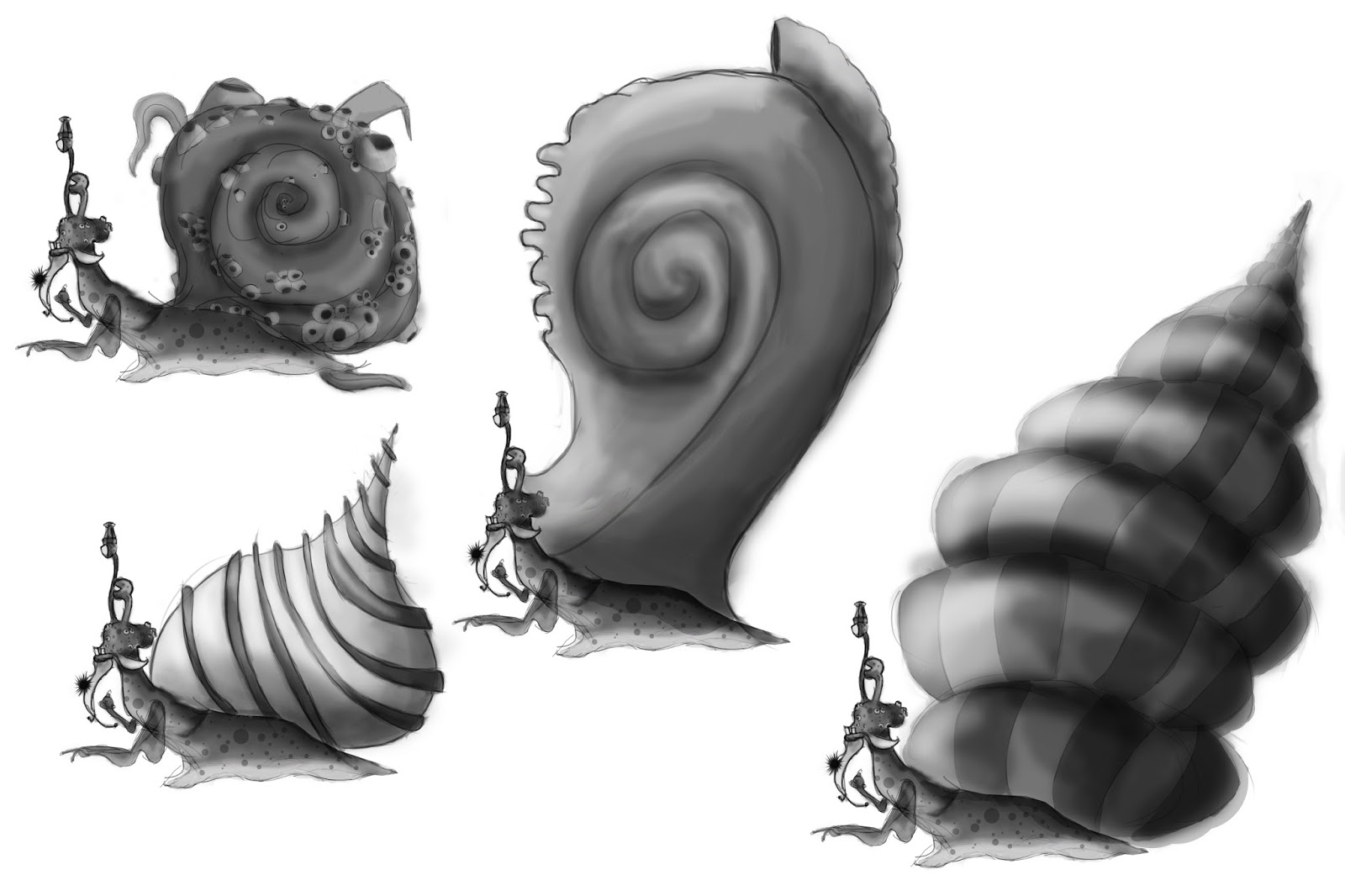
Scribbling these two forms out, I liked the idea of my salesman being some form of seasnail by twilight, his huge bagpack filled with wares becoming a snailshell. The idea of Guybrush making puns about my "Snailsman" who could've once been a "snailor" amused me too much not to push the idea forward.

From here I started iteration, focusing on head design to lead the rest of the character.


I was really fond of the original face, but decided upon the bearded head as I thought it was the most expressive, appearing as a more well-kept person- I also like the idea of attaching a snail shell to his beard.


Having a clearer idea of the head, I had little idea about the rest of the body, so did some quick sketches playing with shape and posture. A more sort of "Gollum" like crouched posture appealed, yet a more sophisticated, taller, thinner character also seemed like it could work, a little like the Happy Mask Salesman from Majora's Mask.


I eventually made the head more disheveled, extending the beard and adding nautical paraphenalia, however a compass monocle was an idea I quite enjoyed. I then played with body shapes, posture, costumes and colour.


Putting different objects on the backpack could really add some dynamics to the overall silhouette- I was most fond of No. 3 as of the sleeves and position, I feel he's be really tall but permanently crouching under the weight of his wares. I was fond of the sombrero, but preferred the hat from No. 2 due to the interesting shape.


   I like the idea of the coat being patchwork, handstitched from loose scraps taken from what washed into the cove, anything he finds being anything he sells. The hat he wears would have a coin attached, the first he found and what he took as a sign to become a salesman. I wasn't originally too keen on more rustic colours, so tried a more clownish palette.

However, I went back to my original colours, I just removed the blue and opted for purple instead.

I then started work designing the Twilight form, that of a snail. I imagined this "spooky twilight realm" to be like that in A Link to the Past, where people animals reflective of who they are, a sea snail in this guy's case.


Sketching out head designs for this form, I opted with the highest one, though a barnacle beard could've been a quirky feature.

I wasn't sure about placeent of the hat and originally wanted it held aloft by his right eye, but now think it better on his left to make the overall shape more harmonious.


I then started playing with shell designs, but felt the first, more traditional shell would fit the world of Monkey Island better and keep with the similarities of the human rucksack.

The interest would therefore be in the details, adding crystals to the barnacles and then a whole treasure chest, flag and seaweed. This I feel more comic and fitting.


I wanted colder colours for the twilight form, to contrast the human one and fit better with the them. I went with the bottom right as I felt it worked the best. Im quite keen on the idea of my snailsman sellking things that latch onto his shell, heeping his earnings in his chest. All things to be explored in the character sheet!

The human's bag I went back and redesigned, scribbling some loose shapes to the detail.


I now have enough to work on model sheets, character sheets and a final illustration, shall get on!